





A faulty transmission control module (TCM) most often causes limp mode with the gearbox stuck in one gear, harsh jolts when you select D or R, erratic gear changes, flashing PRND letters and a gearbox or engine warning light. However, the same symptoms are often caused by a low gearbox oil level, a weak battery, a poor earth or a faulty sensor. To test a transmission control module, start by checking the battery and reading the fault codes with a diagnostic tool that can talk to the gearbox control unit, then check the power supply, the connector, the oil and the live data. Below we explain the symptoms, the diagnostic steps and what the most common fault codes mean.
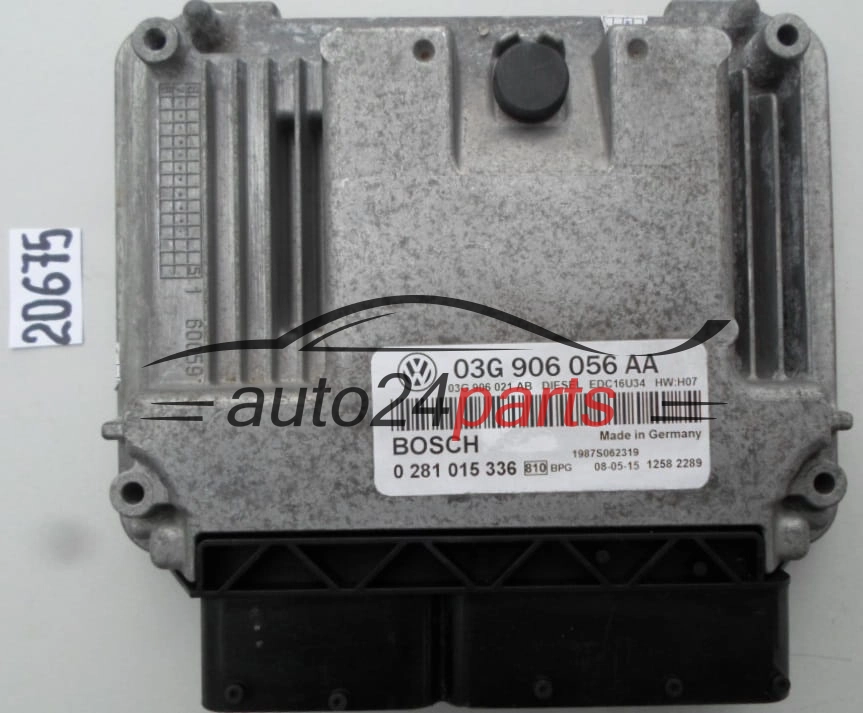
Engine control unit Seat Leon 1.9 TDI Bosch EDC16U34 03G906056AA 0281015336
Vendors's code: 03G906056AA
Product code: 0281015336
Barcode:
Code 39:
ISBN:
£92.63
Price
£92.63
£113.94
Price
£113.94

Select a product option:
Individual variants may differ in price
product option
Important: Depending on the ECU type and vehicle model, not all of the options listed below may be available.
To select the correct option for your vehicle and ECU, please contact us before purchasing:
contact@auto24parts.com
1. Locked
This option is intended for professional workshops with the required specialist equipment and technical knowledge.
The ECU has been removed from a vehicle intended for recycling and still contains the immobilizer data and other information from the previous vehicle. Before it can be used in another car, it must be unlocked and then programmed using specialist automotive diagnostic equipment.
2. Unlocked
Several preparation methods may be available. The possible options depend on the ECU type, vehicle model and immobilizer system. Please contact us before purchasing, as some preparation methods are not available for every ECU.
Our electronics specialists can prepare the ECU in one of the following ways:
a) ECU with PIN code (Car Pass)
The PIN code is supplied, but programming with a suitable diagnostic tool is still required. After installing the ECU, it must be reset using the supplied PIN code and then programmed to the vehicle’s immobilizer system.
b) VIRGIN ECU
The data from the previous vehicle is removed and the ECU is restored to a clean, factory-like state. After installation, it must be programmed to the vehicle using a compatible specialist diagnostic tool. Unless another preparation method is specified in the product description, this is the standard unlocking option for most of our ECUs.
c) Plug & Play – IMMO OFF
The immobilizer function is disabled in the ECU. After installation, the engine can start without additional immobilizer programming. Please note that the vehicle will no longer have an active immobilizer function, and an immobilizer warning light or fault code may remain, depending on the vehicle model.
d) Plug & Play – Automatic Programming
After installation, the ECU automatically learns and saves the required vehicle data. No additional programming is normally required.
e) Plug & Play – 1:1 Clone
The data from your original ECU is copied to another fully functional ECU. The cloned unit is then ready for installation without additional programming.
You must send us your original ECU so that we can transfer its data to the replacement unit.
The original ECU must have working communication with the vehicle, a diagnostic tool or our programming equipment. If the required data cannot be read, a complete 1:1 clone may not be possible.
3. Complete Plug & Play Set
A complete matched set containing the ECU, immobilizer components and all other parts required to start the vehicle without additional programming. All components supplied in the set must be installed in the vehicle.
Important:
Dispatch time depends on the selected option. If an unlocked or specially prepared version is ordered, the preparation service usually requires an additional 1–2 business days.
Ask about the product

Engine control unit Seat Leon 1.9 TDI Bosch EDC16U34 03G906056AA 0281015336
Administratorem danych osobowych jest Auto24parts. Przetwarzamy je w celu przesłania odpowiedzi na zapytanie. Więcej informacji dotyczących przetwarzania danych osobowych znajduje się w polityce prywatności.
Shipping
from
£22.79
-
shipping
(Poland)
from
£22.79
-
shipping
(Poland)
Price 30 euros applies shipments to 5 kg on worldwide. Above this weight, please contact us by email to check price
Shipping cost for the selected product
The shipping cost applies to this product (in the selected variant - if applicable). It may change after adding other products to the cart.

03G906056AA engine ECU for your Seat Leon 1.9 TDI – how to check the fit
We offer a used, fully working Bosch engine control unit with part numbers 03G906056AA and 0281015336. It fits if the same numbers appear on the label of the ECU in your car. Available locked or unlocked.
Engine control unit Seat Leon 1.9 TDI Bosch EDC16U34 03G906056AA 0281015336
The Bosch module 03G906056AA controls the engine – it reads sensor data and uses it to regulate the fuel system. It is a part for the Seat Leon 1.9 TDI.
ECU markings
- 0281015336 – Bosch number, also printed as 0 281 015 336
- 03G906056AA – Seat part number, also printed as 03G 906 056 AA
- 03G906021AB – Seat part number, also printed as 03G 906 021 AB
- EDC16U34 – Bosch ECU type
Compare them with the sticker on the ECU in your car. The number decides the fit, not the model alone – Seat used different ECU versions.
Typical fault symptoms
- the engine will not start despite a good power and fuel supply,
- no communication with the ECU during diagnostics,
- limp mode with no sensor fault,
- damage after water ingress or a voltage spike.
Before replacing the ECU, check the power supply, earths and wiring loom – a damaged wire or connector can cause similar symptoms.
Locked or unlocked version?
In the locked version the ECU still stores the data of the car it came from and needs programming at a garage. The unlocked version is prepared by us before dispatch.
Not every unlocking method is possible for every ECU – it depends on the number, the software and the car’s immobiliser. Before ordering the unlocked version, ask us about the options for the 03G906056AA ECU.
All variants are described on our Locked & Unlocked ECUs page.
Frequently asked questions
| Is 0281015336 the same ECU as 03G906056AA? |
|---|
| Yes. Both numbers appear on the label of the same ECU. |
| Will the ECU start the engine straight after fitting? |
| The locked version will not – it needs programming and matching to the immobiliser. With the unlocked version it depends on the preparation method, which we agree before purchase. |
| What condition is the ECU in? |
| It is a used part, fully working and in good condition. The warranty period is shown in the product features table. |
Need help choosing? Contact us at contact@auto24parts.com.
