





Peugeot ECU – HDi, SID208, EDC16 & DCM Engine Control Units
Peugeot ECU – engine control units by PSA number, HDi system and ECU family
The correct Peugeot engine control unit should be selected using the complete references printed on the original ECU label. Peugeot modules commonly combine a PSA OEM number beginning with 96... or 98... with an additional Bosch, Continental, Delphi, Magneti Marelli or other electronics manufacturer reference. Important ECU families in the range include EDC16, DCM6.2A, SID208, IAW and older Bosch petrol systems.
The Auto24Parts range includes Peugeot engine computers for models such as 206, 306, 307, 407 and Boxer, covering both petrol and HDi applications. Depending on the exact module, locked, ready-for-programming, VIRGIN or selected Plug & Play preparation variants may be available. See our ECU preparation options for details.
If you are unsure which Peugeot ECU matches your vehicle, send Auto24Parts a clear photo of the complete original ECU label together with the model, year, engine capacity and engine version, or browse the complete engine control unit catalogue.
List of products
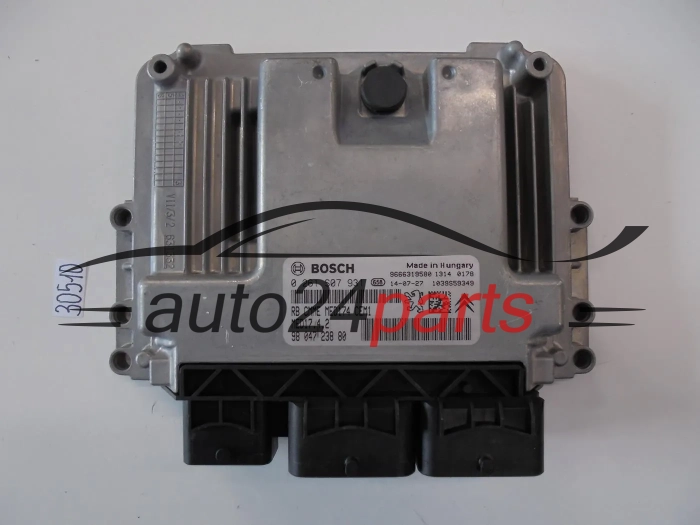

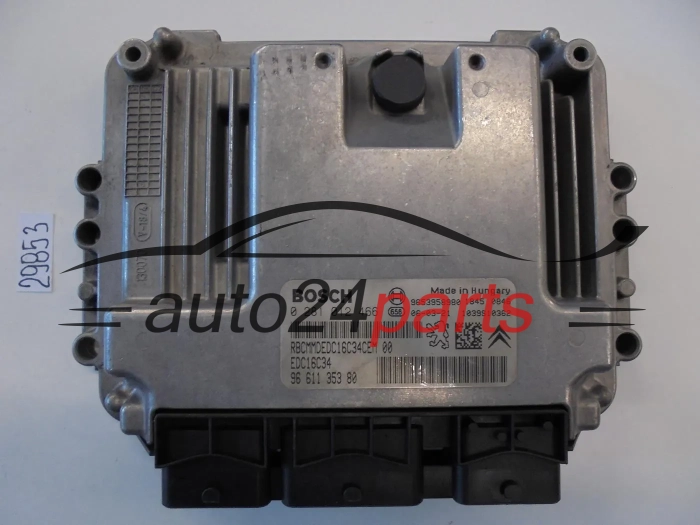
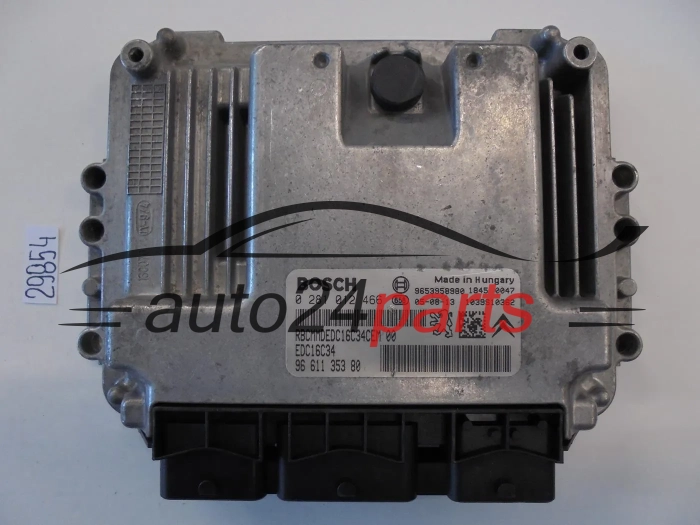

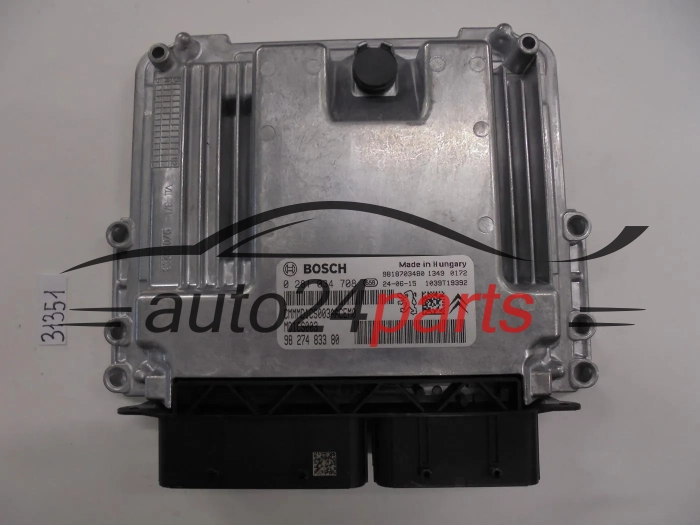
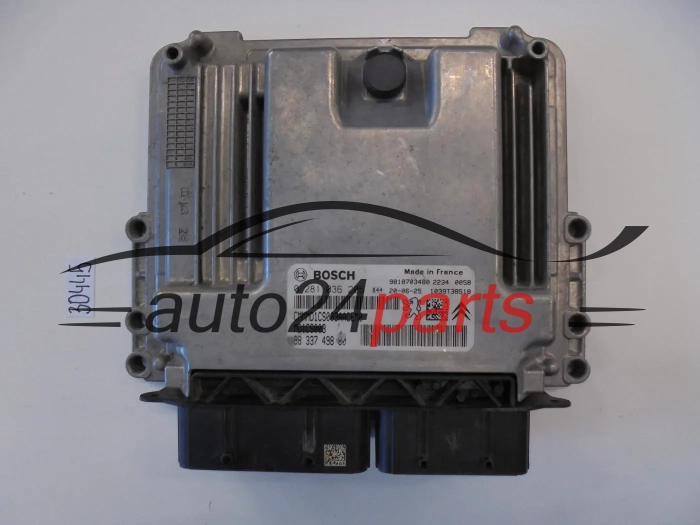
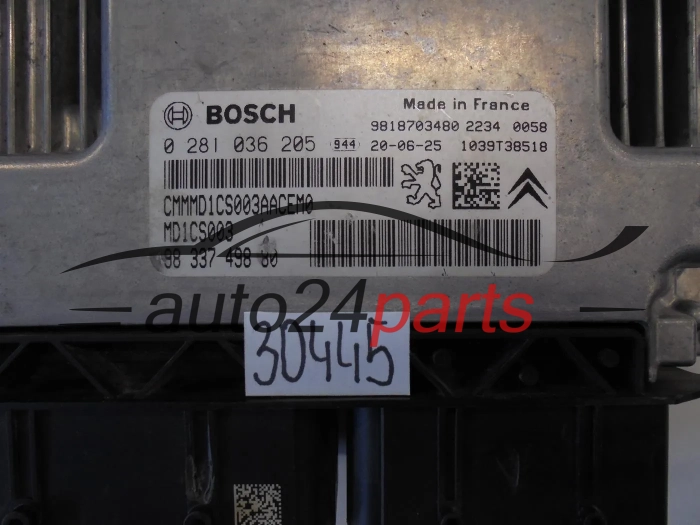


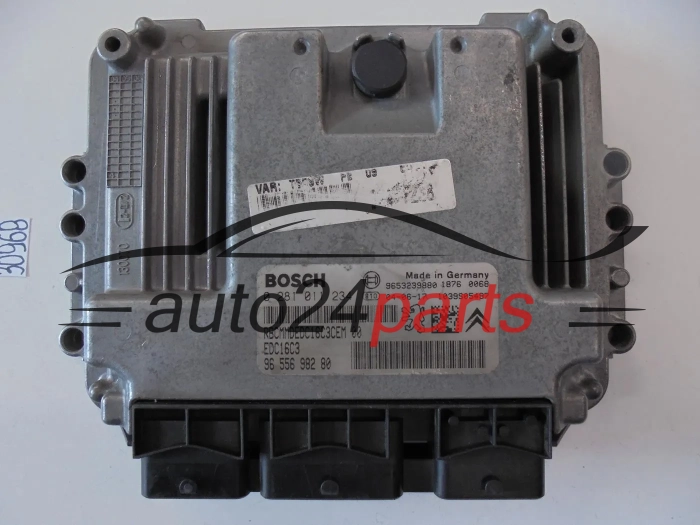
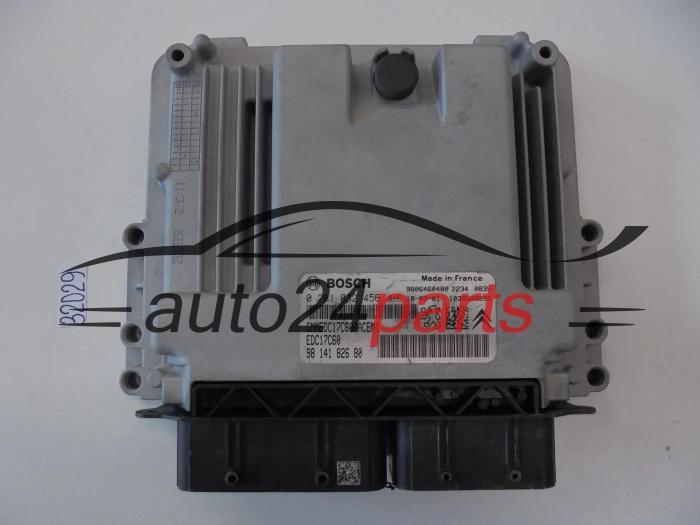
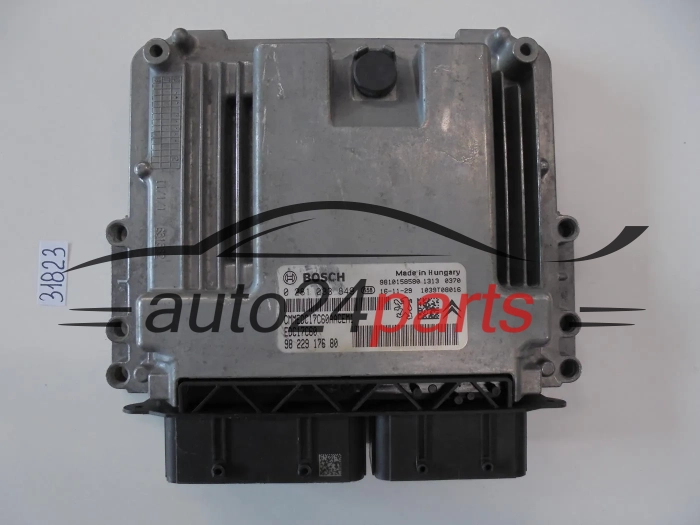
Peugeot engine control units – ECU identification by PSA and manufacturer part number
A Peugeot engine control unit (ECU), also known as an ECM or engine computer, manages engine operation and communicates with other electronic systems in the vehicle. Depending on the engine and ECU generation, the module may control fuel injection, ignition in petrol engines, fuel pressure, turbocharger operation, electronic throttle control and selected emissions-related systems.
When replacing a Peugeot ECU, the most important step is identifying the exact electronic module fitted to the vehicle. Peugeot has used many engine-management generations from Bosch, Continental, Delphi, Magneti Marelli, Sagem and other manufacturers. Similar housings and connectors do not guarantee identical hardware, software or vehicle-specific security data.
Peugeot and PSA ECU numbers beginning with 96 and 98
Many Peugeot engine control units use PSA OEM references beginning with 96... or 98.... Examples found in the current Auto24Parts range include:
- 9632693780,
- 9637839480,
- 9646313280,
- 9644157380,
- 9662213380,
- 9663318680,
- 9809447980,
- 9828241380,
- 9679061580.
The prefix alone is not sufficient. The complete PSA number, electronics manufacturer reference and ECU family should be checked together.
Why can one Peugeot ECU have several different numbers?
A Peugeot ECU label can contain several references identifying different aspects of the control unit. Depending on the module, these may include:
- Peugeot / PSA OEM number,
- Bosch, Continental, Delphi, Magneti Marelli or Sagem reference,
- ECU family such as EDC16C34, DCM6.2A, SID208 or IAW6LPB,
- hardware and software identification,
- additional calibration or production numbers.
Searching with several numbers from the original label is normally more accurate than searching only for a phrase such as “Peugeot 307 ECU” or “Peugeot HDi ECU”.
Peugeot 206 – Bosch 0261206213 / 9632693780
One of the available older petrol control units is the Peugeot 206 Bosch ECU 0261206213 / 9632693780.
The Bosch reference can also be written as 0 261 206 213. The Peugeot / PSA number 9632693780 provides the second important identifier.
The product is offered in locked and ready-for-programming preparation variants. The required version should be selected according to the vehicle and the programming procedure that will be carried out after installation.
Peugeot 306 1.6 – Bosch 0261206861 / 9637839480 / M7.4.4
For Peugeot 306 1.6, the catalogue includes the Peugeot ECU Bosch 0261206861 / 9637839480 / M7.4.4.
The unit also carries the ID03 designation. The combination of PSA number, Bosch number, M7.4.4 family and additional identification makes the search much more precise than the model and engine capacity alone.
Peugeot 307 1.4 HDi – Bosch 0281010390 / 9646313280
A characteristic diesel module is the Peugeot 307 1.4 HDi ECU Bosch 0281010390 / 9646313280 / 9644157380.
The Bosch number may also be written as 0 281 010 390. This ECU appears in the EDC16 generation and demonstrates why several PSA numbers can occur alongside one Bosch hardware family.
For this reason, a search for “Peugeot 307 1.4 HDi ECU” should be narrowed using the complete numbers printed on the original module.
Peugeot 407 / Citroën C4 – 0281012984 / 9662213380 / EDC16C34
Another diesel example is the Peugeot 407 / Citroën C4 Bosch ECU 0281012984 / 9662213380 / EDC16C34.
This unit combines Bosch reference 0281012984, PSA number 9662213380 and the EDC16C34 engine-management family.
A shared Peugeot / Citroën application does not mean that every EDC16C34 ECU is interchangeable. Complete part numbers, software, hardware and vehicle configuration must still be verified.
Peugeot 2.0 HDi – 9809447980 / 28494513 / DCM6.2A
A newer Delphi diesel engine controller is the Peugeot 2.0 HDi ECU 9809447980 / 28494513 / DCM6.2A.
The module is identified by PSA number 9809447980, Delphi reference 28494513 and the ECU family DCM6.2A.
The product is currently offered as locked or unlocked / ready for programming. This illustrates why the ECU family alone is not enough — the complete PSA and Delphi references remain essential.
Peugeot 0281034826 / 9828241380
The range also includes the Peugeot ECU Bosch 0281034826 / 9828241380.
This module uses a newer Bosch 028103... numbering sequence together with PSA reference 9828241380. The complete combination should be compared with the original unit rather than relying only on the external appearance of the ECU.
Peugeot 307 / 407 2.0 – IAW6LPB / 9663318680
Peugeot petrol applications also use Magneti Marelli engine-management systems. One example is the Peugeot 307 / 407 2.0 ECU IAW6LPB / IAW 6LPB / 9663318680.
The same IAW designation can appear as IAW6LPB or IAW 6LPB. The corresponding PSA reference is 9663318680.
This product is currently available in locked and ready-for-programming variants.
Peugeot IAW6LP2.03 – 9647498180 / 9654722680
Another Magneti Marelli application is the Peugeot ECU IAW6LP2.03 / IAW6LP203 / 9647498180 / 9654722680.
This example is useful for exact-number searches because the family designation may appear both with and without punctuation: IAW6LP2.03 or IAW6LP203.
Peugeot Boxer 2.2 HDi – SID208 S180129001E / 9679061580
A particularly important commercial-vehicle ECU in the current range is the SID208 S180129001E / 9679061580 ECU for Peugeot Boxer 2.2 HDi.
This Continental SID208 unit combines manufacturer reference S180129001E with PSA / Fiat-family number 9679061580. The current product is specifically offered in a Plug & Play prepared version.
SID208 is especially important for Peugeot Boxer and related commercial-vehicle applications. The complete S180129... reference and PSA number should be checked because the SID208 family contains several different hardware and software variants.
Peugeot HDi engine control units – EDC16, DCM and SID families
Peugeot diesel applications cover several generations of engine management. Current catalogue examples include:
- 0281010390 / 9646313280 – Bosch EDC16 generation, Peugeot 307 1.4 HDi,
- 0281012984 / 9662213380 / EDC16C34 – Peugeot 407 / Citroën C4,
- 9809447980 / 28494513 / DCM6.2A – Peugeot 2.0 HDi,
- S180129001E / 9679061580 / SID208 – Peugeot Boxer 2.2 HDi.
The phrase “Peugeot HDi ECU” therefore covers several completely different engine-management architectures. The exact family and part number should always be identified.
Peugeot petrol ECUs – Bosch, Magneti Marelli and Sagem
The current Peugeot range also contains numerous petrol engine control units from earlier generations. These include Bosch systems such as M7.4.4, Magneti Marelli IAW modules and Sagem control units.
Examples include:
- 0261206213 / 9632693780 – Peugeot 206 Bosch ECU,
- 0261206861 / 9637839480 / M7.4.4 – Peugeot 306 1.6,
- IAW6LPB / 9663318680 – Peugeot 307 / 407 2.0,
- IAW6LP2.03 / 9647498180 / 9654722680.
The electronics manufacturer and ECU family are useful search filters, but the complete PSA number remains essential.
Peugeot, Citroën and shared PSA engine control units
Peugeot and Citroën share numerous engines, platforms and electronic systems. As a result, some engine control units are listed for both brands.
For example, 0281012984 / 9662213380 / EDC16C34 is listed for Peugeot 407 and Citroën C4, while other PSA modules can appear across several vehicle models.
This does not make every Peugeot and Citroën ECU interchangeable. Exact OEM numbers, manufacturer references, hardware, software and vehicle configuration must still be checked.
Related products can be found in the Citroën engine control unit category.
Peugeot ECU, BSI and immobiliser
In many Peugeot vehicles, engine-start authorisation involves communication between the engine ECU, the BSI and the vehicle security system.
A standard used ECU can retain data from its previous vehicle. Depending on the ECU and vehicle generation, programming, synchronisation, data transfer or another preparation procedure may therefore be required before the replacement unit can operate correctly.
The exact procedure should always be determined for the specific module rather than assuming that every Peugeot ECU is installed in the same way.
Peugeot ECU telecoding and vehicle configuration
Depending on the vehicle and ECU family, configuration after replacement may include parameters associated with the engine, transmission and selected vehicle equipment.
Some Peugeot applications may therefore require coding or telecoding after installation. The exact procedure depends on how the replacement ECU has been prepared and on the vehicle generation.
Used / locked Peugeot ECU
A standard used / locked Peugeot engine control unit normally retains information from its previous vehicle. Such a module is mainly intended for workshops or automotive electronics specialists equipped to prepare and programme replacement ECUs.
The required work depends on the control-unit family and vehicle security system.
Peugeot ECU ready for programming
Many Peugeot products in the Auto24Parts catalogue are available in locked and ready-for-programming variants. The exact preparation options depend on the control unit and vehicle.
Programming, coding, BSI synchronisation or another adaptation procedure may still be required after installation.
See the ECU preparation options page for more information.
VIRGIN Peugeot ECU
For selected Peugeot engine control units, a module may be reset or prepared in a VIRGIN state for subsequent adaptation to the vehicle.
The required procedure after installation depends on the ECU family. A VIRGIN module should therefore not automatically be treated as Plug & Play unless the specific product description states otherwise.
Plug & Play Peugeot ECU
Selected Peugeot products may be offered in a specifically prepared Plug & Play version. One current example is the SID208 S180129001E / 9679061580 unit listed for Peugeot Boxer 2.2 HDi and related commercial-vehicle applications.
Plug & Play availability is product-specific and should not be assumed for every Peugeot ECU.
Peugeot ECU cloning
For selected compatible modules, Peugeot ECU cloning may be another preparation method. If the required data can be correctly read from the original ECU, relevant information can be transferred to a suitable replacement module.
Depending on the control-unit design, this may include memory data, software, configuration and immobiliser-related information.
The possibility of cloning depends on the ECU family and the condition of the original module. If the required data cannot be recovered, another preparation method may be necessary.
Why the complete Peugeot ECU label matters
A replacement Peugeot ECU should not be selected only by vehicle model, engine capacity, housing shape or connector arrangement. The preferred identification sequence is:
- complete Peugeot / PSA OEM number,
- Bosch, Continental, Delphi, Magneti Marelli, Sagem or other manufacturer reference,
- ECU family such as EDC16C34, DCM6.2A, SID208, M7.4.4 or IAW,
- hardware and software references where available,
- vehicle model and production year,
- engine capacity and engine version,
- transmission and relevant vehicle equipment where required.
Common symptoms that may indicate a Peugeot ECU problem
A defective engine control unit can cause different symptoms, but similar problems may also result from sensors, wiring, actuators, fuel-system components, power-supply faults or communication problems.
- engine does not start,
- no diagnostic communication with the ECU,
- engine stalls or is difficult to restart,
- limp mode or reduced engine power,
- injector or ignition-control faults,
- incorrect throttle response,
- fuel-pressure or turbocharger-control problems,
- communication faults between vehicle modules,
- diagnostic trouble codes that repeatedly return,
- internal ECU memory or electronics faults.
Before replacing the ECU, check battery voltage, control-unit power supply, grounds, fuses, relays, connectors and wiring. A stored fault code alone does not prove that the engine control unit itself is defective.
Peugeot engine control units by exact part number
Searching by the complete PSA and electronics manufacturer references is one of the most effective ways to locate the correct Peugeot ECU:
- 0261206213 / 9632693780 – Peugeot 206 Bosch ECU
- 0261206861 / 9637839480 / M7.4.4 – Peugeot 306 1.6 ECU
- 0281010390 / 9646313280 / 9644157380 – Peugeot 307 1.4 HDi
- 0281012984 / 9662213380 / EDC16C34 – Peugeot 407 / Citroën C4
- 9809447980 / 28494513 / DCM6.2A – Peugeot 2.0 HDi
- IAW6LPB / 9663318680 – Peugeot 307 / 407 2.0 ECU
- IAW6LP2.03 / 9647498180 / 9654722680 – Peugeot ECU
- 0281034826 / 9828241380 – Peugeot Bosch ECU
- S180129001E / 9679061580 / SID208 – Peugeot Boxer 2.2 HDi Plug & Play ECU
How to check Peugeot ECU compatibility before ordering
Take a clear photo of the complete original ECU label. The Peugeot / PSA OEM number, Bosch, Continental, Delphi, Magneti Marelli or other manufacturer reference, ECU-family designation and any hardware or software identifiers should all be readable.
If you need help identifying the correct replacement module, contact Auto24Parts and send the photo together with the Peugeot model, model year, engine capacity, power output and engine version.
For other vehicle makes, browse the complete engine control unit catalogue. Related PSA modules can also be found in the Citroën engine control unit category and Peugeot braking electronics in the Peugeot ABS pump category.
Before ordering, you can also review our How to Buy guide, Shipping & Delivery information and Returns, Warranty & Complaints conditions.
FAQ – Peugeot ECU and Engine Control Units
| Question | Answer |
|---|---|
| How do I find the correct Peugeot ECU? | Compare the complete Peugeot / PSA OEM number with the Bosch, Continental, Delphi, Magneti Marelli or other manufacturer reference printed on the original ECU. ECU family, hardware, software and vehicle information should be used as additional verification. |
| Why do many Peugeot ECU numbers begin with 96 or 98? | Many PSA electronic modules use OEM numbers beginning with 96 or 98. The complete reference is required because the common prefix alone does not confirm ECU compatibility. |
| Are 0281010390 and 9646313280 references for the same Peugeot 307 ECU? | These references appear together on the corresponding Peugeot 307 1.4 HDi Bosch engine control unit. The product also carries PSA number 9644157380. |
| What is DCM6.2A on a Peugeot ECU? | DCM6.2A is an engine-control family used in selected Peugeot diesel applications. One current Auto24Parts unit carries references 9809447980, 28494513 and DCM6.2A. |
| What is SID208 on a Peugeot Boxer? | SID208 is an engine-management family used in selected 2.2 HDi commercial-vehicle applications. One current Peugeot Boxer unit is identified by S180129001E and 9679061580. |
| Are IAW6LPB and IAW 6LPB the same ECU designation? | Yes. They are two formatting variants of the same designation used on the Peugeot 307 / 407 2.0 module carrying PSA reference 9663318680. |
| Does a used Peugeot ECU require programming? | It depends on the ECU and preparation variant. A standard used / locked module may require preparation, programming and immobiliser-related adaptation, while selected units may be available ready for programming, as VIRGIN or in a specific Plug & Play version. |
| What is the role of the BSI when replacing a Peugeot ECU? | In many Peugeot vehicles, the BSI participates in vehicle security and configuration. Depending on the vehicle and ECU preparation, synchronisation, programming or data transfer may be required after ECU replacement. |
| Can a Peugeot ECU be cloned? | Cloning may be possible for selected compatible modules when the required data can be correctly read from the original ECU. Availability depends on the control-unit design and condition of the original module. |
| Are Peugeot and Citroën ECUs interchangeable? | Some PSA control units are used in applications from both brands, but this does not make all modules interchangeable. The complete OEM number, manufacturer reference, hardware, software and vehicle configuration must still be checked. |
| Can two Peugeot ECUs with identical connectors be different? | Yes. Similar housings and connectors do not confirm identical hardware, software, calibration or immobiliser data. The complete ECU label should always be compared. |
| What should I send to check Peugeot ECU compatibility? | Send a clear photo of the complete original ECU label together with the Peugeot model, model year, engine capacity, power output and engine version. All PSA and electronics manufacturer references should be readable. |