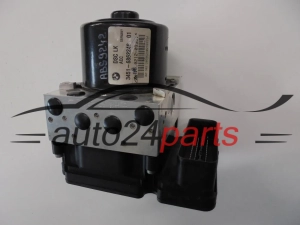
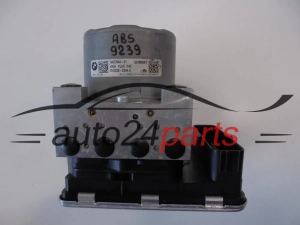
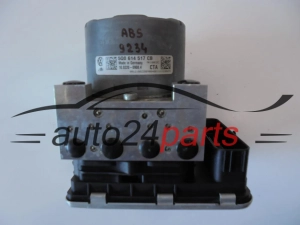
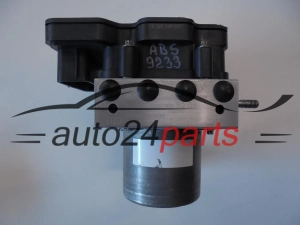
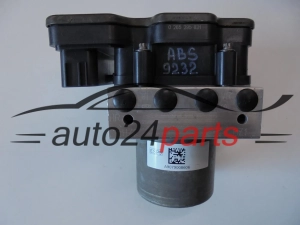
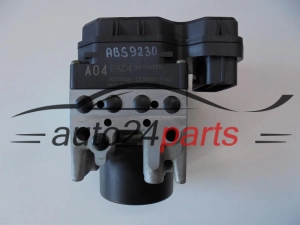
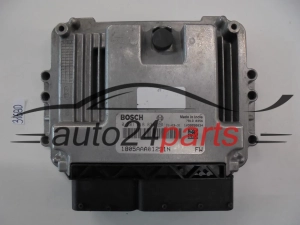
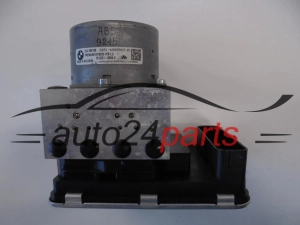
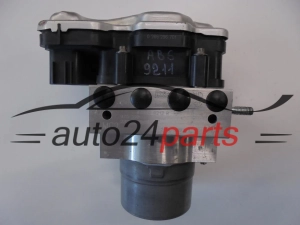
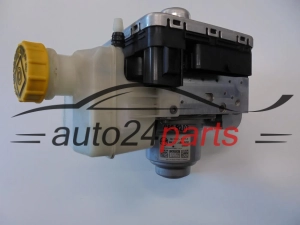
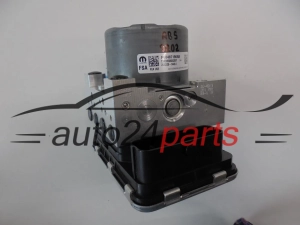
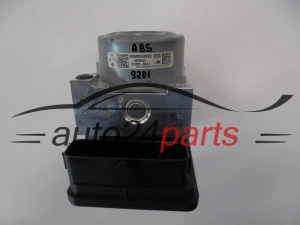
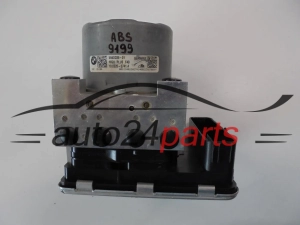
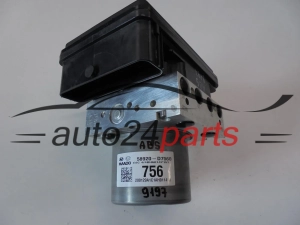
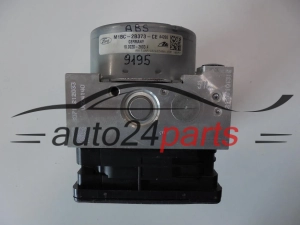
A rainy day, driving through a deep puddle, or simply a car parked under a tree with falling leaves. Suddenly, your dashboard lights up like a "Christmas tree" – ABS, ESP, parking brake failure lights, and often a lack of speedometer readings. The mechanic's diagnosis can be ruthless: a water-damaged ABS pump control module.
This is one of the most annoying automotive electronic failures. In such a situation, many drivers start looking for ways to dry, test, or revive the damaged module. Unfortunately, in the case of electronics operating within the braking system, such attempts are usually throwing money down the drain.
Why does this happen, and how can you permanently solve this problem?
Where does the water in the ABS control module come from?
ABS pump control modules are hermetically sealed at the factory, but their placement in the engine compartment is often unfortunate. The most common causes of water damage are:
-
Clogged scuttle panel drains: This is an absolute plague in many brands (e.g., Renault, Audi, VW). Leaves and dirt clog the drainage channels. Rainwater, instead of draining under the car, collects in the scuttle panel area, creating a "pool" where the ABS pump ultimately ends up.
-
Aggressive engine washing: Using a pressure washer from too close a distance can push water through the plug seals straight onto the pins of the integrated circuit.
-
Lack of under-engine shields: Driving through deep puddles without a bottom shield causes water to hit electronic components directly.
What are the symptoms of a water-damaged module?
When water gets into the delicate electronics of the control module where current is flowing, short circuits occur immediately. Typical symptoms include:
-
Lack of any communication between the diagnostic computer and the ABS control module.
-
The ABS pump motor runs continuously, even after removing the key from the ignition (until the battery is completely discharged).
-
Communication errors on the CAN bus – a damaged ABS control module can "scatter" errors throughout the entire car, causing, for example, the gearbox to go into limp mode or engine starting problems.
Drying, testing, and rebuilding – why is it a bad idea?
When we find out the module is water-damaged, the first thought is to take it to an electronics technician for "testing" or "cleaning". This is a trap that only generates unnecessary costs.
Here is why attempts to save a water-damaged ABS miss the point:
-
Electrolysis destroys tracks in seconds: Dirt-contaminated water is an excellent conductor. When it connects powered pins on the motherboard, electrolysis occurs. The thin, microscopic copper tracks on the board simply evaporate or turn into green oxide.
-
Diagnosis costs with no guarantee of success: Just opening the hermetic module casing and "examining" it under a microscope costs money. Even if the technician manages to remove visible corrosion and the car stops displaying errors for a moment, no one will guarantee that water hasn't damaged the inner layers of the multi-layer PCB.
-
A ticking time bomb: A "dried out" module might work for a week or a month. However, the oxidation process progresses slowly. You risk the ABS failing during emergency braking on the highway.
-
Lack of factory sealing: Once opened and glued with silicone, the module will never be as tight as when factory-welded. In the humid environment under the hood, it will quickly accumulate moisture again.
The Only Reasonable Solution: An Original, Used ABS Pump
Instead of paying an electronics technician for pointless hours of attempting to resuscitate a "corpse", a much safer, faster, and often cheaper solution is to purchase an original, used ABS pump.
Why is this the best choice?
-
Factory seal: You are buying a component that has never been opened. You can be sure that its casing will withstand the rigors of operation.
-
Saving time and money: You don't pay for diagnostics, cleaning, and shipping to remanufacturing services. You remove the old pump, install a working used original with the same numbers, and the car is back on the road.
-
High quality of components: Original parts used for initial assembly (OEM) are incomparably more durable than any repair attempts.
Just read the numbers from your water-damaged pump (e.g., Bosch, ATE numbers, or the car manufacturer's numbers) and select an identical component from a reliable source.
Do not risk your safety and do not waste time on experiments in electronic workshops. You can find a verified, original pump for your car at the following link: Buy a working, original ABS pump – Check the offer at Auto24Parts.
FAQ – Frequently Asked Questions about a Water-Damaged ABS Control Module
1. Can a water-damaged ABS control module work properly again after drying? Very rarely, and usually only for a short while. Water (especially dirty water from a puddle or scuttle panel) is an excellent conductor of electricity. When it gets into a working integrated circuit, it immediately causes short circuits and the process of electrolysis, which irreversibly destroys the microscopic tracks on the motherboard. Even if the water evaporates, conductive residue and pockets of corrosion remain inside.
2. The mechanic suggested washing the contacts with isopropyl alcohol. Will this help? Cleaning the contacts of the external plug is a good first diagnostic step. However, if water has gotten inside the hermetic casing of the control module (which is very common with water damage), cleaning from the outside will do nothing. Corrosion inside the system will progress, and the problem will return when you least expect it.
3. Why does the ABS pump motor run all the time, even after removing the key from the ignition? This is one of the most classic symptoms of water damage. Moisture causes a short circuit on the motherboard, which "glues" (sticks) the relay powering the pump's electric motor. In this situation, you must immediately disconnect the plug from the pump or remove its fuse; otherwise, the pump motor will drain the battery to zero, and the pump itself may burn out from overheating.
4. How can I be sure that the water-damaged control module is to blame, and not, for example, a wheel sensor? A wheel sensor usually generates an error for only one specific wheel (e.g., "No signal from the left front wheel"). If the control module is water-damaged, there is usually no communication with it at all via the diagnostic computer, it throws pump motor power supply errors, or it "scatters" errors from many other systems at once on the dashboard (gearbox, steering system).
5. Can water in the ABS control module damage other computers in the car? Yes. Modern cars are connected by a CAN (Controller Area Network) bus. A water-damaged ABS module can cause a short circuit on the CAN communication line, which disrupts the operation of other modules. This can result in the automatic transmission going into limp mode, all gauge needles dropping to zero, or even the inability to start the engine.
6. Do I have to buy a complete pump (with the hydraulic block), or is the black plastic control module enough? If water has only damaged the electronics, theoretically it is enough to replace just the plastic control module. However, in practice, finding just the module with identical numbers is very difficult. Moreover, by purchasing a complete, unopened used pump, you are guaranteed that no one has previously broken the seal between the hydraulics and the electronics. Often, it is fastest and cheapest to replace the whole thing.
7. Can I safely drive a car with the plug disconnected from a water-damaged ABS? You can drive to a workshop, but you must exercise extreme caution. The braking system will retain its mechanical/hydraulic properties (the car will brake), but wheel lock-up will occur much faster. You completely lose the ABS system, ESP (electronic stability program), and in many cars – speedometer readings and power steering.
8. How can I prevent the new pump from getting water-damaged again in the future? Prevention is key. If the pump is located in the scuttle panel (e.g., in many Audi, VW, Renault models), regularly check and clear the rubber water drains. Leaves and mud accumulating there create a blockage. If the pump is low in the bumper, make sure you have all the plastic wheel arches and the lower engine shield installed.
9. Is it necessary to code a used pump after installation? It depends on the year and brand of the vehicle. In cars before 2005, it is often enough to connect a pump with matching numbers. In newer cars, the ABS control module is coded to a specific vehicle VIN, engine type, and wheel size. After replacing it with a used one, it is necessary to calibrate the steering angle sensor and code it (so-called adaptation) using a diagnostic computer.
10. Can leaking brake fluid damage electronics the same way water does? Yes, and even faster. Brake fluid is highly corrosive and hygroscopic (absorbs water). If, due to a leak in the hydraulic block, the fluid gets into the electronic part, it instantly "eats" the tracks and protective coatings on the motherboard. The effect is identical to rainwater damage.
11. Why are there no new, cheap replacement ABS pumps on the market? The ABS system is a critical vehicle safety component. Its production, calibration, and certification process is extremely rigorous and expensive. For this reason, there are no Chinese "cheap replacements" for entire ABS units. The only parts available on the market are original parts (OEM – Bosch, ATE, TRW, Continental) from authorized dealerships (very expensive) or original used parts from dismantling.
12. Where can I find the numbers on a water-damaged pump to select the right part? The numbers are usually found in two places:
-
On a sticker placed on the round, metal pump motor.
-
Engraved or glued on the plastic electronic part (control module). You must write down the main vehicle manufacturer's number (e.g., for VW it starts with 1K0... or 5Q0...) and the part manufacturer's number (e.g., for Bosch it is usually 0 265 ... ...).