





Accelerator Pedals and Pedal Position Sensors
Accelerator Pedals and Pedal Position Sensors
Auto24Parts offers used original accelerator pedal modules, pedal position sensors and accelerator pedal potentiometers for many vehicle brands. The catalogue includes parts manufactured by Bosch, Hella and other OEM suppliers.
The safest way to choose the correct pedal is to compare the complete OEM number and manufacturer number with the original unit. Common references include Bosch 028075..., 028100... and 020500..., Hella 6PV... and vehicle-specific numbers such as Ford 9F836.
Examples include VW T4 7D1721603B / 6PV00777011, Ford Transit 1C11-9F836-AD and Audi / Seat / VW Bosch 0280755063 / 6Q1721503F.
If you are unsure which part is correct, send us a clear photo of the original pedal label before ordering.
List of products
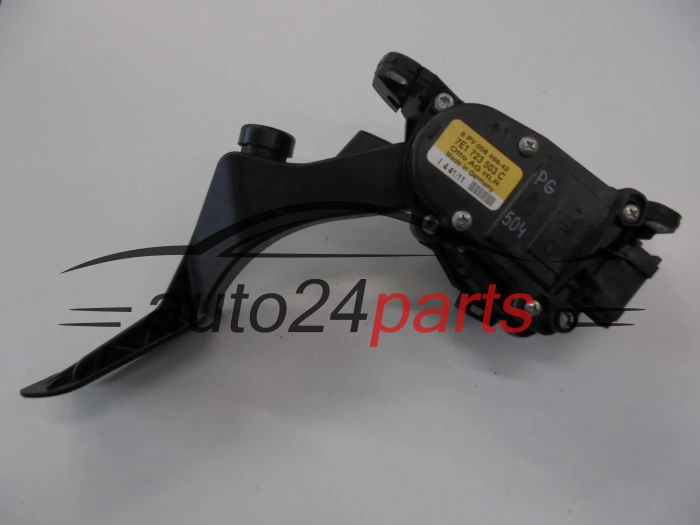
Accelerator Pedal – Potentiometer and Pedal Position Sensor
An accelerator pedal module sends the driver's acceleration request to the engine management system. In modern vehicles, the pedal is usually electronic and contains one or more position sensors rather than a traditional mechanical cable connected directly to the throttle body.
The same component may be searched for as:
- accelerator pedal,
- gas pedal,
- accelerator pedal sensor,
- pedal position sensor,
- accelerator pedal potentiometer,
- electronic accelerator pedal,
- APP sensor – Accelerator Pedal Position sensor.
Although “potentiometer” is still widely used as a search term, not every modern pedal module uses a traditional resistive potentiometer. Different sensor technologies can be used depending on the vehicle and manufacturer.
How does an electronic accelerator pedal work?
In a modern drive-by-wire system, pressing the accelerator pedal does not directly open the throttle body with a cable. Instead, the pedal module sends one or more electrical position signals to the engine ECU.
The ECU interprets the driver's request together with other information such as engine speed, load, traction-control input and vehicle operating conditions. It then controls the throttle body, fuel injection or other engine-management functions.
This means the pedal reports driver demand; it does not directly determine fuel quantity or throttle opening by itself.
Accelerator pedal vs throttle body
The accelerator pedal and throttle body are separate components.
The accelerator pedal measures how far the driver presses the pedal and sends that request to the ECU. The throttle body is an actuator in the intake system that may regulate airflow according to commands from the ECU.
A fault in either component can sometimes cause similar symptoms, which is why diagnosis should be performed before replacing parts.
Why do accelerator pedals use more than one position signal?
Electronic accelerator pedals commonly use redundant position signals for safety. The engine ECU can compare these signals and detect implausible or inconsistent values.
If the signals do not correspond correctly, the ECU may limit engine response or activate a reduced-power mode.
Depending on the vehicle, diagnostic fault codes may refer to accelerator pedal position sensor circuit A, circuit B or correlation between the signals.
How to choose the correct accelerator pedal
The safest way to select a replacement pedal is to compare all references shown on the original part.
Check:
- complete vehicle OEM number,
- manufacturer number,
- all suffix letters,
- additional hardware or production codes where present,
- vehicle make and model as supporting information.
Two accelerator pedals can have the same shape and connector while using different sensors, calibration or electronics.
The vehicle model alone should therefore not be treated as proof of compatibility.
Bosch accelerator pedals
Bosch is one of the main manufacturers represented in this category.
Common Bosch number families found on accelerator pedal modules include:
- 028075...,
- 028100...,
- 020500....
Examples from the catalogue include:
- 0280755063 / 6Q1721503F – Audi / Seat / Volkswagen,
- 0281002339 / 028907475AP – Volkswagen,
- 0205001020 / 7D0721727 – Volkswagen T4,
- 0281002296 / 09129107 – Opel Vectra B,
- 0281002561 / A6393000604 – Mercedes Vito.
The common Bosch prefix does not mean that the pedals are interchangeable. The complete number must be compared.
Audi / Seat / Volkswagen – Bosch 0280755063 / 6Q1721503F
One example is the Audi / Seat / Volkswagen accelerator pedal Bosch 0280755063 / 6Q1721503F.
Important references include:
- 0 280 755 063,
- 0280755063,
- 6Q1721503F.
When several references are present on the pedal, it is best to compare the complete combination.
Volkswagen – Bosch 0281002339 / 028907475AP
The catalogue also includes the Volkswagen accelerator pedal Bosch 0281002339 / 028907475AP.
The main identifiers are:
- 0 281 002 339,
- 0281002339,
- 028907475AP.
The final letters in an OEM number such as AP are part of the complete reference and should not be ignored.
Hella accelerator pedal modules – 6PV numbers
Hella accelerator pedals frequently use references beginning with 6PV....
Examples currently visible in the catalogue include:
- 6PV00777011 / 7D1721603B – Volkswagen T4,
- 6PV00849501 / 6Q1721503B – Volkswagen Polo / Seat Leon / Ibiza,
- 6PV00922001 / 6G929F836BD – Volvo V70 / S60,
- 6PV00830100 / 30865642 – Volvo S40 / V40,
- 6PV00853701 / 30636004 – Volvo S60.
The full 6PV reference should be checked because visually similar Hella pedals may have different final digits.
Volkswagen T4 – 7D1721603B / Hella 6PV00777011
A strong long-tail example is the Volkswagen T4 accelerator pedal 7D1721603B / Hella 6PV00777011.
It can be searched in several forms:
- 7D1 721 603 B,
- 7D1721603B,
- 6PV 007 770-11,
- 6PV00777011.
Using both the VW and Hella references makes identification more precise.
Volkswagen Polo / Seat Leon / Ibiza – 6PV00849501 / 6Q1721503B
Another catalogue example is the Volkswagen Polo / Seat Leon / Ibiza accelerator pedal 6PV00849501 / 6Q1721503B.
Important numbers:
- 6PV 008 495-01,
- 6PV00849501,
- 6Q1 721 503 B,
- 6Q1721503B.
Again, the full suffix should be retained when comparing the part.
Ford accelerator pedals – 9F836 references
Ford commonly uses 9F836 within accelerator-pedal part numbers.
One confirmed example is the Ford Transit 2.4 TDDI accelerator pedal 1C11-9F836-AD.
The part may be written as:
- 1C11-9F836-AD,
- 1C119F836AD.
The complete prefix and suffix matter. A shared 9F836 base number does not mean that all Ford accelerator pedals are interchangeable.
Volvo V70 / S60 – 6G92-9F836-BD / Hella 6PV00922001
The catalogue also includes a Volvo V70 / S60 accelerator pedal 6G92-9F836-BD / Hella 6PV00922001.
Important references:
- 6G92-9F836-BD,
- 6G929F836BD,
- 6PV 009 220-01,
- 6PV00922001.
Combining the vehicle-specific number with the Hella reference gives a more accurate search result.
Why suffix letters are important
Accelerator pedal numbers often end with letters that identify a specific version.
For example:
- 6Q1721503B,
- 6Q1721503F,
- 1C11-9F836-AD,
- 6G92-9F836-BD,
- 028907475AP.
These suffixes are part of the complete reference and should not be removed when searching or comparing parts.
Common symptoms of a faulty accelerator pedal sensor
Possible symptoms can include:
- delayed or missing accelerator response,
- limited engine power,
- limp mode,
- uneven response while pressing the pedal,
- engine speed not increasing normally,
- accelerator pedal position fault codes,
- implausible signal or sensor-correlation errors.
These symptoms do not automatically confirm a failed pedal module.
What should be checked before replacing the accelerator pedal?
Before replacing the pedal, it is worth checking:
- electrical connector condition,
- wiring between the pedal and ECU,
- power or reference voltage where applicable,
- ground connections,
- live diagnostic values from pedal position sensors,
- related ECU fault codes.
Wiring problems or poor electrical connections can produce symptoms similar to a faulty pedal sensor.
Does a replacement accelerator pedal require programming?
Many accelerator pedal modules do not require coding or programming after replacement, but this should not be treated as a universal rule.
Depending on the vehicle, installation may involve:
- direct replacement with no programming,
- clearing stored fault codes,
- checking live pedal-position values,
- performing a relearn or basic setting if required by the vehicle system.
The correct procedure depends on the vehicle manufacturer and engine-management system.
Can an accelerator pedal cause limp mode?
Yes. If the ECU detects missing, implausible or mismatched accelerator pedal signals, it may reduce engine response for safety.
However, similar reduced-power symptoms can also originate from the throttle body, engine ECU, wiring or other engine-management components.
How to search for an accelerator pedal by part number
Useful search combinations include:
- accelerator pedal 7D1721603B 6PV00777011,
- VW T4 gas pedal 6PV00777011,
- Ford Transit accelerator pedal 1C119F836AD,
- Audi Seat VW pedal 0280755063 6Q1721503F,
- Volkswagen accelerator pedal 0281002339 028907475AP,
- Volvo accelerator pedal 6G929F836BD 6PV00922001,
- VW Polo Seat Leon accelerator pedal 6PV00849501 6Q1721503B.
Searching with the complete OEM and manufacturer references normally gives much more precise results than using only the vehicle model.
Selected accelerator pedals in the Auto24Parts catalogue
Examples include the Volkswagen T4 7D1721603B / 6PV00777011 pedal, the Ford Transit 1C11-9F836-AD accelerator pedal, the Audi / Seat / VW Bosch 0280755063 / 6Q1721503F unit and the Volvo V70 / S60 6G929F836BD / 6PV00922001 pedal.
Related electronic car parts
- Electronic Car Parts
- Throttle Bodies
- Engine Control Units – ECU
- Vehicle Control Modules
- Bosch Automotive Electronics
How to confirm compatibility before ordering
If you are unsure which accelerator pedal is correct, contact Auto24Parts.
For compatibility verification, send:
- a clear photo of the complete original pedal label,
- all OEM numbers,
- manufacturer number,
- vehicle make and model,
- production year,
- engine version if known.
The complete part numbers from the original pedal are more reliable than the vehicle model alone.
Ordering, Payment, Delivery and Returns
Ordering information is available in our How to Buy guide. Payment options are listed under Secure Payment Methods, while shipping information can be found on the Shipping & Delivery page.
Current information about returns, complaints and warranty is available under Returns, Warranty & Complaints.
FAQ – Accelerator Pedals and Pedal Position Sensors
| Question | Answer |
|---|---|
| How do I choose the correct accelerator pedal? | Compare the complete OEM number and manufacturer number with the original pedal. Vehicle model and engine version are useful supporting information but should not replace part-number verification. |
| Is an accelerator pedal potentiometer the same as a pedal position sensor? | The terms are often used for the same type of pedal-position function, but not every modern pedal uses a traditional resistive potentiometer. The complete part number is more important than the terminology. |
| Is the accelerator pedal the same as the throttle body? | No. The pedal measures driver demand and sends it to the ECU. The throttle body is a separate actuator that controls airflow in applicable engine systems. |
| Can a faulty accelerator pedal cause limp mode? | Yes. If the ECU detects missing or inconsistent pedal-position signals, it can reduce engine response for safety. Wiring or other engine-management faults can cause similar symptoms. |
| Does an accelerator pedal need programming after replacement? | Many pedal modules can be replaced without programming, but procedures vary by vehicle. Some systems may require fault-code clearing, signal verification or a relearn procedure. |
| What does Hella 6PV mean? | 6PV is commonly found in Hella accelerator-pedal references. The complete number, such as 6PV00777011 or 6PV00849501, should be checked because different variants are not automatically interchangeable. |
| What do Bosch 028075 and 028100 numbers mean? | They are Bosch part-number families used on various accelerator pedal modules. The complete number and vehicle OEM reference should be compared before ordering. |
| Does the Ford 9F836 number identify one accelerator pedal? | No. 9F836 is part of Ford accelerator-pedal numbering. The complete reference, including prefix and suffix such as 1C11-9F836-AD, should be used. |
| Can two accelerator pedals with identical connectors be different? | Yes. The housing and connector may be the same while the sensor characteristics or electronics differ. Always compare the full reference numbers. |
| What information should I send to confirm compatibility? | Send a clear photo of the complete original pedal label, all visible part numbers and basic vehicle information such as make, model, year and engine version. |